Translation
memory reverse leverage is the ability to leverage TM content using
the stored target information within a TM entry as if it were the
source content, in order to provide translation support from the
target language into the source language of the TM entry. In short,
the TM reverse leverage operation reverses the source and target
designations of segments within a TM entry, thus allowing for translation
support of the target language into the source language.
When a TM is leveraged during the leverage process or during the
pretranslation process, the system checks to see if the TM has been
enabled to support reverse leveraging. If it has, the system first
looks for TM entries that were stored for the desired language pair
based on the source and target designations within the TM entries.
If a qualifying match has not been found, then a reverse lookup is
attempted. That is, forward-leverage matches are chosen over reverse-leverage
matches from the same TM
If you are leveraging across a TM Group, reverse-leverage matches
take precedence over equally scored matches from lesser ranked TMs
in the group.
Reverse leveraging differs from "forward" leveraging (the default)
in the following ways:
-
A configurable penalty is assessed to control auto-leverage.The tm_score_reverse_leverage_penalty TM property in tm.properties can be configured to penalize reverse leveraged matches. The default value is 0. The allowed values must be in the range of 0 to 1. This penalty is a leverage level penalty, and as such, it is applied to the entire match. (Many penalties are applied to the segment element—such as a word or number in the segment—that causes the penalty.) As a result, the impact of the penalty is not affected by the length of the segment. For example, if the penalty is set to 0.02, then the final score will be reduced by 2 percentage points. Based on this value, the maximum score that a reverse leverage match could generate is a 98% score.
Reverse leverage is useful if you have content in the same subject
area being developed in multiple languages. For example, if you have
some of your documentation written in English and some written in
French, and the subject matter is similar, you could use common TMs
for both. Without reverse leverage, only the matches in the direction
you are translating to can be used. With reverse leverage, the matches
in both directions can be used.
To illustrate this, consider the following example, in which the
first TM (TM1) has four English to French segment pairs and one French
to English pair, and a second TM (TM2) in this TM group has three
French to English pairs (that is, TM2 is a bilingual TM, with entries
in only one source language—French. TM1 has reverse leveraging enabled,
allowing it to capture both English to French and French to English
matches. And, finally, suppose TM1 is the primary TM in the group.
Table 3: TM Contents
|
TM Name
|
Source Language
|
Target Language
|
Source Text
|
Target Text
|
|---|---|---|---|---|
|
TM1
|
English
|
French
|
The cat in the hat.
|
Le chat dans le chapeau.
|
|
TM1
|
English
|
French
|
The 3 little bears.
|
Les 3 peu ours.
|
|
TM1
|
English
|
French
|
There is nothing like this anywhere.
|
Il n'y a rien comme ceci n'importe où.
|
|
TM1
|
English
|
French
|
Where are all of the children hiding?
|
D'où tous les enfants se cachent?
|
|
TM1
|
French
|
English
|
Les 3 peu ours.
|
3 little bears.
|
|
TM2
|
French
|
English
|
Pourquoi est-ce que tous les enfants
se cachent?
|
Why are all of the children hiding?
|
|
TM2
|
French
|
English
|
Trop de cuisiniers dans le pot !
|
Too many cooks in the pot!
|
|
TM2
|
French
|
English
|
Le chat dans le chapeau.
|
A cat in the hat.
|
The following table compiles the lookup results for a number of search
strings.
Table 4: Lookup Results
|
Lookup Text
|
Preferred Match
|
Assigned As Reverse Match?
|
TM Used (and why))
|
|
|---|---|---|---|---|
|
Le chat dans le chapeau.
|
The cat in the hat.
|
Yes.
|
TM1 provides a 100% reverse match. The
reverse match was available from higher ranked TM, and so the forward
match was not accepted.
|
|
|
Les 3 peu ours.
|
3 little bears.
|
No. Although a reverse match was available,
there was a forward match available from the same TM.
|
TM 1. TM 1 also provides a 100% reverse
match.
|
|
|
Il n'y a rien comme ceci n'importe où.
|
(R) There is nothing like this anywhere.
|
There is nothing like this anywhere.
|
Yes.
|
TM1.
|
|
D'où tous les enfants se cachent?
|
Where are all of the children hiding?
|
Yes.
|
TM1.
|
|
|
Pourquoi est-ce que tous les enfants
se cachent?
|
Why are all of the children hiding?
|
No.
|
TM2.
|
This example applies the following leverage rules: Reverse leverage
matches are ranked below other equally scored matches from the same
TM. Forward or normal leveraged exact matches are ranked higher than
reverse leveraged exact matches from the same TM. The same holds true
for equally scored fuzzy matches.
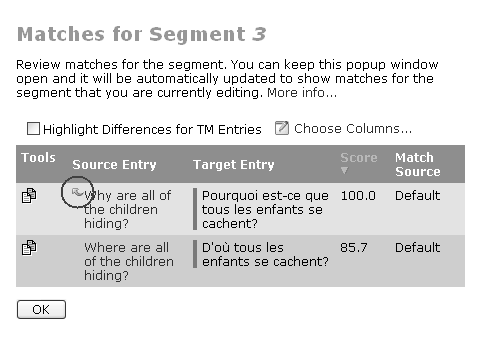
The TM entries page from the Browser Workbench displays both normal
and reverse leveraged matches. For example, if you perform a TM lookup
in the Browser Workbench, you might see the following: