

| Verifying the Language Pair Support |
It is essential for the translation provider plug-in to verify whether the language pair that was selected when opening a document (or when creating a project) is actually supported by the selected translation provider source, i.e. in our implementation the delimited text file. If a user has selected e.g. Japanese -> French when opening a document for translation, but the delimited list contains Italian -> Spanish segment pairs, the text file should be rejected as a translation provider.
 Requirements for Checking the Language Direction in our Implementation
Remember that the first line of a delimited text file is required to contain the language pair with the source target languages being separated by the specified delimiting character, e.g.:
en-US;de_DE
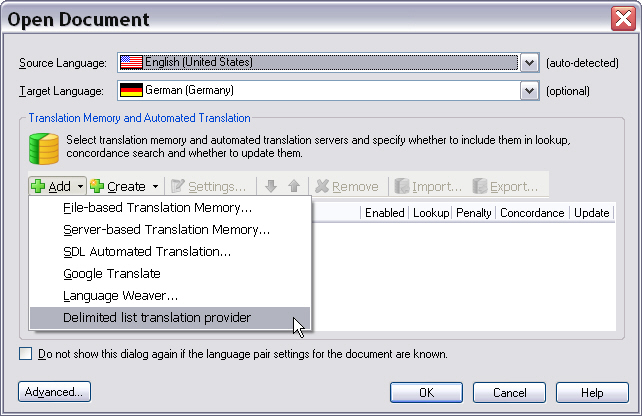
In the following screenshot English (US) is selected as the source language, the target language is German (Germany). The API would therefore return en-US for the source language SourceCultureName, and de-DE for the target language, i.e. the TargetCultureName property. These strings map, of course, nicely to the locale combination of our list files, which makes checking whether the selected language pair actually fits the selected list very easy.
(In other implementations, the translation provider that you connect to might not allow for such an easy mapping of languages, which means that you may have to develop a more involved application logic for verifying the validity of the language combination.)
The requirement is to check whether the selected language pair actually fits the translation provider, or whether the language pair is supported by the translation provider in the first place. For example, if you connect to an automated translation service that does not support Japanese, but the user has selected Japanese as source or target language, then a corresponding message needs to be thrown, and the user should not be allowed to select this particular translation provider.
Implement the Logic for Checking the Language DirectionThe logic for checking the language direction is implemented within the SupportsLanguageDirection method of the ITranslationProvider interface. This method takes a region-qualified source-target language combination object as parameter. This object holds the information on the languages that were selected by the user in the user interface of SDL Trados Studio 2017, and which needs to be compared to the language direction of the translation provider.
We start by opening the text file and reading the first line:using (StreamReader listFile = new StreamReader(Options.ListFileName)) { firstLine = listFile.ReadLine(); listFile.Close(); }
string[] langs = (firstLine.Split(Convert.ToChar(Options.Delimiter)));
if (langs.Count<string>() != 2)
{
    return false;
}
if (langs[0].ToLower() == languageDirection.SourceCultureName.ToLower()
    && langs[1].ToLower() == languageDirection.TargetCultureName.ToLower())
{
    // The provider supports the selected language direction.
    return true;
}
else
{
    // The provider does not support the selected language direction.
    return false;
}
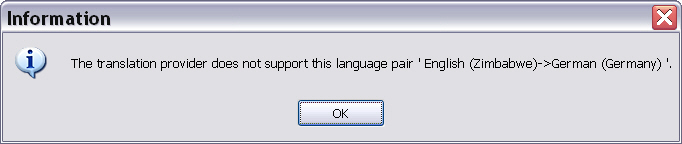
When the method returns False, SDL Trados Studio 2017 will throw a message like the one in the example below when selecting the translation provider:
 Putting it All Together
The complete method should now look as shown below:
public bool SupportsLanguageDirection(LanguagePair languageDirection)
{
    string firstLine = "";
    #region "ReadFirstLine"
    using (StreamReader listFile = new StreamReader(Options.ListFileName))
    {
        firstLine = listFile.ReadLine();
        listFile.Close();
    }
    #endregion

    // Check whether the first line of the text file indicates
    // the language direction, e.g. en-US;de-DE.
    // If the first line cannot be split at the delimiter, the delimited list
    // file should not be accepted as translation provider.
    #region "FirstLineCheck"
    string[] langs = (firstLine.Split(Convert.ToChar(Options.Delimiter)));
    if (langs.Count<string>() != 2)
    {
        return false;
    }

    #endregion

    // This implementation will not be case-sensitive, therefore
    // we use the ToLower() method when comparing the language direction
    // of the delimited file to the language direction that was
    // selected in SDL Trados Studio.
    #region "CompareLanguages"
    if (langs[0].ToLower() == languageDirection.SourceCultureName.ToLower()
        && langs[1].ToLower() == languageDirection.TargetCultureName.ToLower())
    {
        // The provider supports the selected language direction.
        return true;
    }
    else
    {
        // The provider does not support the selected language direction.
        return false;
    }
    #endregion
}
CommunityComments